FAQ
Frequently Asked Questions
We understand that navigating the criminal justice system can be overwhelming. This page is designed to answer some of the most common questions we receive about the District Attorney’s Office, court processes, victims’ rights, and more.
Note: Some answers may also be located on other pages of our website. If you don’t find the information you need here, please explore the rest of our site or use the search bar to help guide your search.
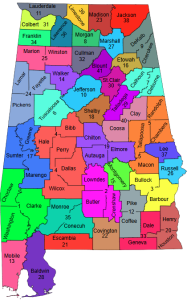
There are 41 judicial circuits that make up Alabama’s Circuit Court system. Each circuit includes one or more counties. Each circuit is represented by an elected District Attorney to represent the State of Alabama in criminal prosecutions and some specific civil matters.
- Marshall County is the only county in the 27th Judicial Circuit (see map below) .
- Alabama has 41 judicial circuits in total, covering all 67 counties, with Circuit Courts handling both criminal and significant civil cases.
Jennifer Bray is the elected District Attorney of Marshall County (27th Judicial Circuit). As the chief prosecutor, her name appears on most court documents and official correspondence; however, she is not personally assigned to every case.
The attorney actually working on your case is likely the Assistant District Attorney whose name appears below hers on the document or letter.
If you need to speak with the prosecutor handling your case or schedule a meeting, please contact our office at (256) 582-8113, and we will connect you with the appropriate person.
Crimes should be reported to the law enforcement agency that has jurisdiction in the area where the incident occurred. For example, if a crime takes place within the city of Guntersville, it should be reported to the Guntersville Police Department. If it occurs in an unincorporated area without a municipal police department, the report should be made to the Marshall County Sheriff’s Office.
Please note that the District Attorney’s Office does not typically take initial crime reports. Once a law enforcement agency investigates and determines that charges are appropriate, the case will be forwarded to the District Attorney’s Office for prosecution.
An assistant district attorney reviews each case brought to the District Attorney's Office by local law enforcement agencies. They decide the appropriate charges to present to the grand jury based on the law and the evidence in the case. Ultimately, it is the grand jury’s decision on what charges to indict an offender on.
The relationship between local law enforcement agencies and the Marshall County District Attorney’s Office is both independent and collaborative.
Local law enforcement agencies—such as city police departments and the Marshall County Sheriff’s Office—are responsible for investigating crimes, making arrests, and submitting reports and evidence. Once a case is submitted, prosecutors in the District Attorney’s Office independently review the materials to determine whether criminal charges should be filed.
The assigned prosecutor will evaluate the evidence, apply the relevant Alabama laws, and decide how best to pursue justice. Depending on the type of case, it may either be:
- Presented to a Grand Jury for possible indictment, or
- Filed directly with the Circuit Clerk’s Office in the form of a criminal complaint to obtain a warrant.
No. The District Attorney’s Office does not initiate child support matters. To receive assistance in opening a child support case, you should contact the Alabama Department of Human Resources (DHR) Child Support Enforcement Division.
In Marshall County, child support services are provided through:
Marshall County DHR – Child Support Enforcement
180 Bluff Road, Guntersville, AL 35976
Phone: (256) 582-7100
Website
A Grand Jury is made up of local citizens randomly selected from within Marshall County. Its purpose is to determine whether there is sufficient legal evidence to formally charge a person with a crime by issuing an indictment.
The District Attorney’s Office presents evidence to the Grand Jury, typically through testimony from the investigating law enforcement officer (such as a deputy from the Marshall County Sheriff’s Office or municipal police officer) and any other key witnesses.
The Grand Jury does not decide guilt or innocence. Instead, it decides whether the evidence presented establishes probable cause to believe that a crime has been committed and that the accused individual committed it.
If the Grand Jury finds that probable cause exists, it will return a "True Bill" (indictment), and the case proceeds in Circuit Court. If not, it returns a "No Bill", and the case does not move forward.
The decision to indict lies solely with the members of the Grand Jury.
An arraignment is a public hearing in which a defendant is formally notified of the charges against them. Generally, the defendant enters a plea of not guilty and waiver of arraignment by filing a simple form with the court.
No. Prosecutors are prohibited from talking to a criminal defendant who is represented by an attorney. Please contact your attorney if you have questions about your case.
Information on inmates currently housed in Marshall County Jail can be found on the Marshall County Sheriff’s Office Inmate Roster.
If a person is serving a prison sentence in an Alabama State Prison, you can find the location of the inmate using the Alabama Department of Corrections (ADOC) Inmate Search tool.
No. In Alabama, criminal charges are brought by the State of Alabama, not by the individual victim. The District Attorney’s Office represents the people of the State, and only a prosecutor has the authority to move for dismissal of the charges in a criminal case.
This means that victims do not have the legal power to "press charges" or "drop charges." While the prosecutor may consider the victim’s wishes, the ultimate decision rests with the District Attorney’s Office.
This process helps ensure that victims are not burdened with the responsibility of prosecution, and it protects them from being pressured, threatened, or manipulated into dropping charges—especially in cases involving domestic violence or abuse.
Yes, you must go to court if you receive a subpoena. If you fail to do so, the judge could impose a fine or a jail sentence. Please bring your subpoena with you to court. If you received a subpoena from the District Attorney’s Office for a trial, you can call our office and be placed “on-call” by our receptionist instead of coming to court.
Witnesses must go to court to testify when they have relevant information and are subpoenaed to do so. It is a civic duty imposed upon all citizens to ensure a just and fair judicial system. Your employer cannot retaliate against you for appearing in court pursuant to a subpoena.
Marshall County has multiple courts, and the location of your case depends on the type of case and the jurisdiction:
State Courts (Circuit & District Court): These courts handle felony cases, certain misdemeanors, civil cases, family court, and more. They are located at:
- Guntersville Courthouse (Main Courthouse) 424 Blount Avenue, Guntersville, AL 35976. Courtrooms are located on the second floor.
- Albertville Courthouse Annex, 133 South Emmett Street, Albertville, AL 35950
Check your subpoena or court notice to confirm the correct location.
Municipal (City) Courts: If you were cited or arrested by a city police department for a misdemeanor or traffic violation, your case may be heard in that city’s Municipal Court. The court location will be printed on your ticket, subpoena, or other court documents.
No. Witnesses must go to court to testify if subpoenaed to do so, even if they have to miss work. This is a civic duty imposed upon all citizens in order to ensure a just and fair judicial system. We try our best to work with victims and witnesses to ensure as little disruption to their everyday lives as possible.
Witnesses in criminal cases are not limited to people who see a crime occur. A person who did not see a crime may still know something about the defendant, other witnesses, the evidence, or something else that is relevant to the criminal prosecution. If you do not know why you are testifying in a particular case, ask the prosecutor who is assigned to the case.
Yes. The defendant has a constitutional right to be present in court to hear what all witnesses say about him/her. When testifying, you will likely be questioned first by the prosecutor and then by the defendant’s attorney.
The District Attorney represents the people of the State of Alabama in criminal court and does not serve as a personal attorney for individual victims. The DA’s Office prosecutes criminal offenses on behalf of the State and does not have the authority to file or handle civil lawsuits for private citizens.
If you are involved in a civil matter (such as seeking a protective order, custody, or suing for damages), you may need to hire your own attorney to represent your personal interests in civil court.
The District Attorney’s Office handles criminal matters and does not represent individuals in civil disputes such as breach of contract, poor workmanship, or consumer complaints—unless there is evidence of criminal intent or fraud (such as theft by deception).
If you believe a crime has occurred, you may file a report with your local law enforcement agency, and it may be referred to our office for review.
For non-criminal issues, you may want to contact:
If you suspect identity theft—such as unauthorized use of your credit card or a stolen driver’s license—you should immediately report it to the law enforcement agency that has jurisdiction where the crime occurred.
- If it happened within a city (such as Guntersville or Albertville), contact the local police department.
- If it occurred in an unincorporated area, contact the Marshall County Sheriff’s Office.
The District Attorney’s Office does not take initial reports of crimes. If the investigating law enforcement agency determines that criminal charges are appropriate, they will forward the case to the DA’s Office for prosecution.
You should also:
- Report the incident to the Alabama Attorney General’s Consumer Protection Division: (800) 392-5658
- Place fraud alerts with the three major credit bureaus
- File a report with the Federal Trade Commission
- Consider contacting the Alabama Law Enforcement Agency (ALEA) to replace a stolen driver's license:
Prompt reporting helps protect you and can aid in holding offenders accountable.
No. The District Attorney's Office cannot provide legal advice or take legal action in such matters. You should consult with a private attorney.
If you do not have a lawyer, you can call Legal Services Alabama at (866) 456-4995, or the Alabama State Bar Lawyer Referral Service at (800) 392-5660.
No. The District Attorney’s Office does not file or obtain protection orders on behalf of individuals. However, you can request a Protection from Abuse (PFA) Order by contacting Domestic Violence Crisis Services at 256-891-9864 during regular business hours or their Crisis Line at 256-891-0019. You may also visit their website for more information.
You may also want to speak with a private attorney for guidance. If you do not have an attorney, the following resources can help: Legal Services Alabama at (866) 456-4995, or the Alabama State Bar Lawyer Referral Service at (800) 392-5660.
For assistance and support, you can also contact:
- National Domestic Violence Hotline: (800) 799-SAFE (7233)
These organizations can help with safety planning, court accompaniment, and filing paperwork related to PFAs.
Please contact your attorney, not the District Attorney’s Office.
Please send your complaint, in writing, to:
District Attorney Jennifer Bray
Marshall County District Attorney’s Office
424 Blount Avenue, Suite 208
Guntersville, AL 35976
Please include all your contact information, any related criminal case numbers, and enclose copies of any relevant documents that may support your complaint. Ensure that you keep the original documents. Upon receipt of your complaint, the District Attorney’s Office will investigate the matter and respond.
If you suspect corruption, misuse of office, or unethical conduct by an elected official or public employee in Alabama, you may report it to the following authorities:
Alabama Ethics Commission
P.O. Box 4840
Montgomery, AL 36103-4840
Phone: (334) 242-2997
Website
Alabama Attorney General’s Office – Special Prosecutions Division: (334) 242-7300 | Website
To find out if an individual is currently in an Alabama State Prison or a Federal Prison, the prison locators at the Alabama Department of Corrections and the Federal Bureau of Prisons should be consulted.
A listing of Alabama Fugitives can be found at the Alabama Bureau of Investigation’s website. There is no centralized online system for accessing information on county or municipal prisoners in Alabama. To obtain this information, you must contact the appropriate jail directly.
You may submit a question through our contact us page.
Got a Question? Send Us a Message.
Our team is ready to help you.