Understanding the Criminal Justice System in Marshall County
The criminal justice system can seem complex and overwhelming for those who are unfamiliar with it. We hope this overview will help you understand how the system works in Marshall County and the role our office plays in the process.
Arrest
When a crime is committed, local law enforcement, including city police departments and the Marshall County Sheriff’s Office, is responsible for investigating and arresting suspects. In some cases, individuals are taken into custody immediately. In others, especially for less serious offenses, a person may receive a written notice to appear in court or may be arrested at a later date.
In Alabama, there are three general types of criminal offenses:
- Infractions/Violations – The least serious offenses that often result in a fine. Examples include speeding, running a red light, and driving without a valid driver’s license.
- Misdemeanors – More serious offenses that can result in up to one year in jail. Examples include first-time shoplifting or DUI.
- Felonies – The most serious crimes that carry a penalty of more than one year in prison. Examples include robbery, burglary, drug trafficking, and murder.
The District Attorney’s Role
The Marshall County District Attorney’s Office represents the State of Alabama in criminal prosecutions. Our job is to objectively seek justice. Our prosecutors, known as Assistant District Attorneys (ADAs), handle all felony cases and most misdemeanors committed in Marshall County. Our office works closely with law enforcement agencies to review evidence, recommend charges, and prepare cases for court.
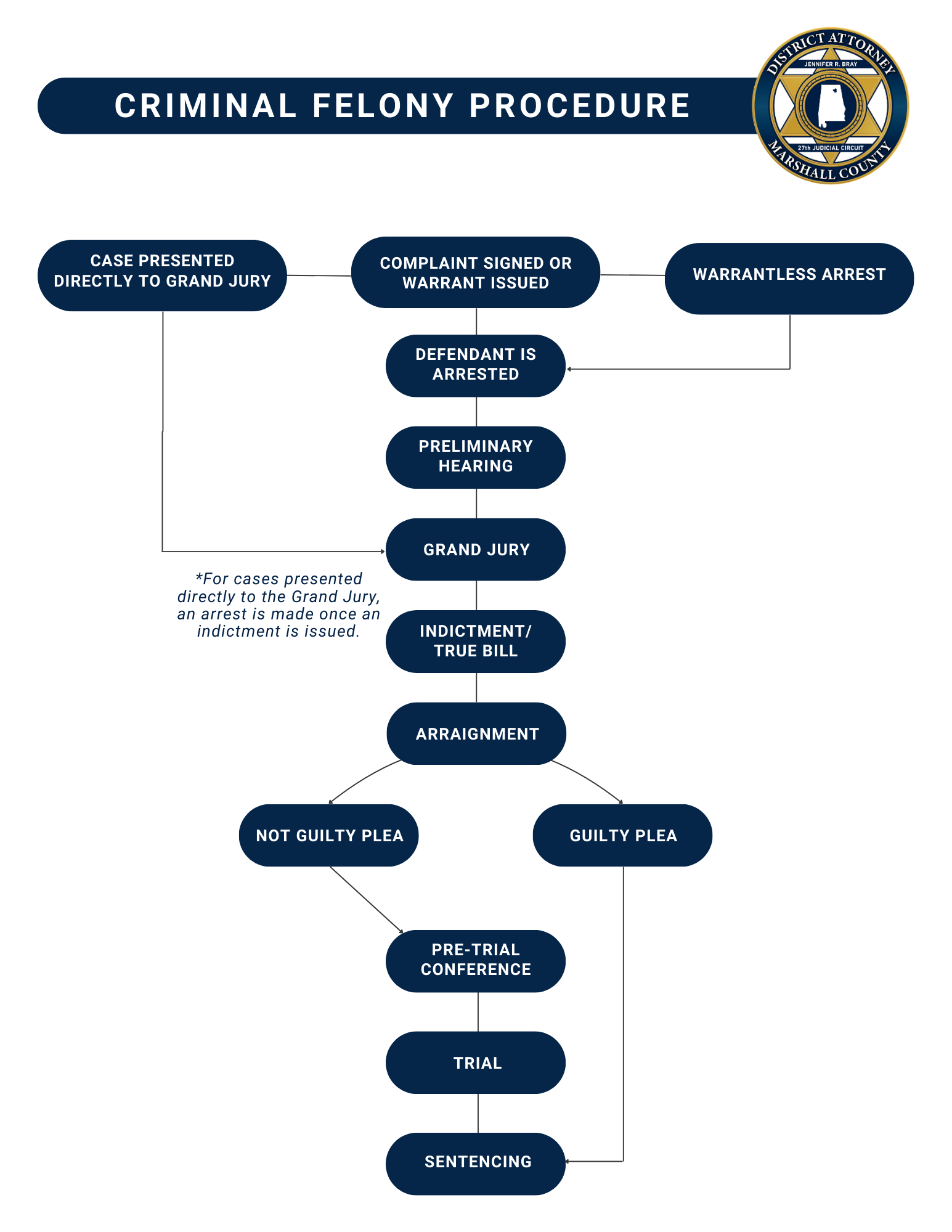
Before charges are filed in felony cases, our office will review the facts with investigators. If the evidence supports prosecution, our office may decide to recommend the officer obtain a warrant or present the case to a Grand Jury. Even if an officer obtains a warrant, the case will still need to proceed to the Grand Jury phase of the court process. The Grand Jury is an important step in felony cases, and more information about that process can be found on the Grand Jury page of our website. If there is not enough evidence, the case may be declined until more investigation is completed.
Bail
Defendants have a constitutional right to bail in criminal cases except in very limited circumstances. Defendants may be held without bail within a judge’s discretion in the following situations: (1) the charges qualify for an Aniah’s Law hearing (most Class A Felony violent offenses), (2) the defendant is charged with capital murder and the judge is convinced of his or her guilt, (3) the defendant violated his or her probation, and (4) the defendant was on bond for another offense and committed a new offense. Bail is money or property pledged to ensure a defendant appears in court. Bail amounts are based on the seriousness of the offense and based primarily on a bail schedule found in Alabama Rules of Criminal Procedure Rule 7.2. Some defendants may be released on their own recognizance, meaning they promise to return without paying bail. The District Attorney’s Office may request certain conditions of release, such as no contact with the victim.
Arraignment
Once an indictment is returned by the Grand Jury, the case is scheduled for arraignment. This phase of the process is primarily a formality where the defendant appears before a judge, is informed of the charges, and most always enters a plea of not guilty so the case can proceed through the court process. If the defendant cannot afford an attorney, one will be appointed for them at the arraignment.
Case Resolution
Many cases are resolved before trial through plea agreements, which are negotiated settlements between the prosecution and the defense that must be approved by a judge. Most plea agreements are entered at the Pretrial Docket. If no agreement is reached, the case proceeds to trial.
Trial Process
If a case goes to trial, it may be heard by a judge or a jury. Most felony trials occur before a jury. The process includes:
- Jury Selection – Potential jurors are questioned by the judge and attorneys to ensure fairness.
- Opening Statements – Both sides outline their case.
- Prosecution’s Case – The District Attorney’s Office presents evidence and calls witnesses, who may be cross-examined by the defense.
- Defense’s Case – The defense may present its own witnesses and evidence, though it is not required to do so.
- Closing Arguments – Both sides summarize their cases.
- Jury Deliberation – The jury decides the verdict. They may find the defendant guilty, not guilty, or be unable to reach a verdict, which is called a “hung jury.” A jury’s verdict must be unanimous.
If the defendant is found guilty, the case proceeds to sentencing. If the defendant is found not guilty, they are acquitted and released.
Disclaimer: This information is provided as a general overview of the criminal justice process in Marshall County, Alabama, and should not be considered legal advice.